
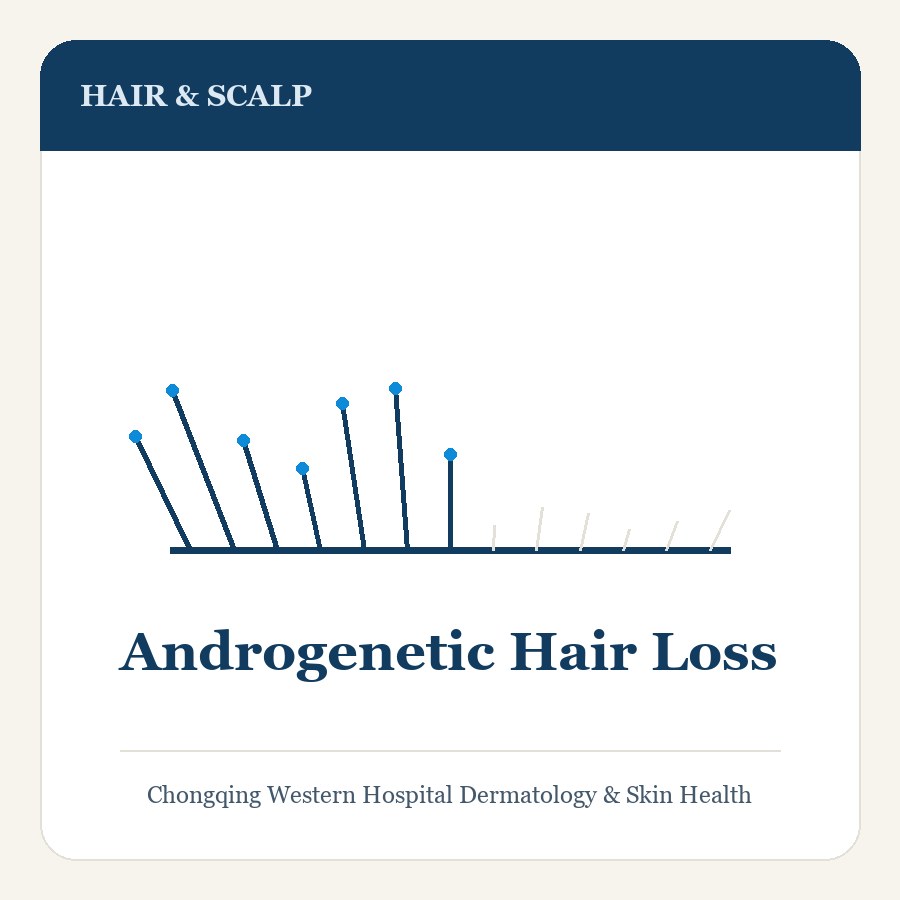
In short. Androgenetic alopecia is pattern hair loss: receding temples and crown thinning in men, a widening part-line and diffuse crown thinning in women. It is genetic in tendency and hormonal in mechanism, driven by follicles sensitive to normal hormone levels, and it is treatable but chronic, so treatment must be long-term. Timing decides how much is preserved.
Key points
- Pattern loss follows a recognisable distribution in men and women, and develops gradually over years.
- Follicles sensitive to normal hormone levels miniaturise, producing finer and shorter hairs.
- Topical treatment is the daily evidence-based foundation and works best on recent thinning.
- Oral hormone-blocking treatment is the most effective medical option for male pattern loss.
- Stopping treatment usually loses preserved hair within months to a year.
What does pattern hair loss look like?
Androgenetic alopecia follows a recognisable distribution: men lose hair at the temples and crown, while women keep the frontal hairline and develop a widening central part-line with diffuse thinning over the crown. It is the most common form of hair loss. The same female pattern can appear with hormone shifts, thyroid disease, and iron deficiency, which is why hair loss in women always asks broader questions. The pace is gradual over years. Sudden shedding in handfuls is a different condition, telogen effluvium, with different causes.
What else could it be?
Telogen effluvium follows illness, surgery, childbirth, crash dieting, or medication by two to three months, and recovers. Alopecia areata causes smooth round bald patches; it is autoimmune, treatable, and often regrows. Tinea capitis, a fungal infection, breaks hairs with scale in children. Diffuse thinning in women prompts thyroid, iron, and hormonal review. A correct diagnosis precedes every treatment.
| Feature | Androgenetic alopecia | Telogen effluvium | Alopecia areata |
|---|---|---|---|
| Distribution | Receding temples and crown thinning in men; widening part-line and diffuse crown thinning in women | Increased shedding, often diffuse | Smooth round bald patches |
| Pace | Gradual over years | Follows a trigger by two to three months | Abrupt patches |
| Hair clue | Finer and shorter miniaturised hairs | Shedding in handfuls | Smooth bald patches |
| Cause or trigger | Genetic tendency and hormonal mechanism, with follicles sensitive to normal hormone levels | Illness, surgery, childbirth, crash dieting, or medication | Autoimmune |
| Course | Chronic and gradual | Recovers | Often regrows |
How is androgenetic alopecia assessed?
Pattern examination, the pull test, and dermoscopy — the diameter diversity of hairs and the miniaturisation pattern — establish the diagnosis clinically. Blood tests are selective, especially in women with diffuse loss. Photography in consistent light documents the baseline, and hair counts track treatment response over six to twelve months.
Treatments that work
Preserve first, regrow second.
- Topical treatment: the evidence-based foundation, used daily; works best on recent thinning.
- Oral treatment for men: a hormone-blocking tablet that is the most effective medical option for male pattern loss, prescribed with discussion of its small risk profile.
- Hormonal options for women: anti-androgen therapy where appropriate, plus correction of contributors such as iron and thyroid.
- Adjuncts: low-level light devices, scalp-care routines, and clinic procedures such as microneedling with growth-factor or regenerative injections — supporting roles, honestly framed.
- Hair transplantation: moves hair from stable donor zones to thinning zones; excellent for the right candidate with stable donor hair, and it does not stop the surrounding loss, so medical treatment continues after surgery.
The transplant conversation
Modern follicular-unit techniques give natural results when hairlines are designed conservatively and donor reserves are respected. The honest cautions: surgery redistributes hair, it does not create it; young men with unstable loss are counselled to stabilise medically first; and the aim is a transplant nobody notices.
Long-term management
Pattern loss is chronic: stopping treatment means losing what treatment preserved, usually within months to a year. The realistic commitment is a daily routine, periodic review, and expectations anchored to preservation — with modest regrowth as a welcome bonus rather than the plan.
When should hair loss be assessed urgently?
- Hair is shedding in handfuls suddenly, or bald patches appear abruptly — different diagnoses, urgent ones occasionally.
- A woman has thinning with irregular periods, excess hair growth, or acne — hormonal review.
- The scalp is red, scaly, or painful with the loss — inflammatory scalp disease needs its own treatment.
Sources
- American Academy of Dermatology — hair loss: diagnosis and treatment information
- British Association of Dermatologists — guideline for the management of androgenetic alopecia
- Cochrane Library — interventions for androgenetic alopecia
Internal links
Frequently asked questions
Can pattern hair loss be reversed?
Treatment genuinely slows pattern loss and partially reverses it, but timing decides results. The daily topical foundation works best on recent thinning, and expectations are anchored to preservation, with modest regrowth as a welcome bonus rather than the plan.
What happens if I stop treatment for hair loss?
Pattern loss is chronic, so stopping treatment means losing what treatment preserved, usually within months to a year. The realistic commitment is a daily routine with periodic review rather than a short course of anything.
Does a hair transplant cure baldness?
No. Surgery redistributes hair rather than creating it, and it does not stop the surrounding loss, so medical treatment continues afterwards. Young men with unstable loss are counselled to stabilize medically first, and the best transplant is the one nobody notices.
Risks & Limitations
- Most chronic skin disease is managed rather than cured, and relapse is expected.
- Treatments typically need 8–12 weeks before response can be judged fairly.
- Topical treatment can cause irritation, dryness, peeling and photosensitivity.
- Systemic therapy may require blood monitoring and carries organ, metabolic and pregnancy risks.
- Isotretinoin in particular requires strict monitoring and pregnancy prevention.
- Pigment change is often slow and may be incomplete.
- No treatment works for everyone, and response cannot be predicted with certainty.
When to Seek Care
- A mole or lesion that changes in size, shape or colour, or starts to bleed, itch or crust.
- Fever with a widespread rash, blistering, or rash involving the eyes, mouth or genitals — seek emergency care.
- Rapidly spreading redness, swelling or pain in the skin.
- Facial swelling or difficulty breathing — possible severe reaction; seek emergency care immediately.
- New or worsening symptoms while taking a monitored medication.
References & Further Reading
- American Academy of Dermatology (AAD) — public and clinical guidance
- World Health Organization (WHO) — skin and infectious disease resources
- Chinese Medical Association, Dermatology Branch — clinical guidance
- Cochrane Library — systematic reviews in dermatology
This page is patient education, not medical advice, and it does not cite individual studies. Discuss your own case with a qualified clinician. To arrange an assessment at Chongqing West District Hospital, see Contact & Consultation.